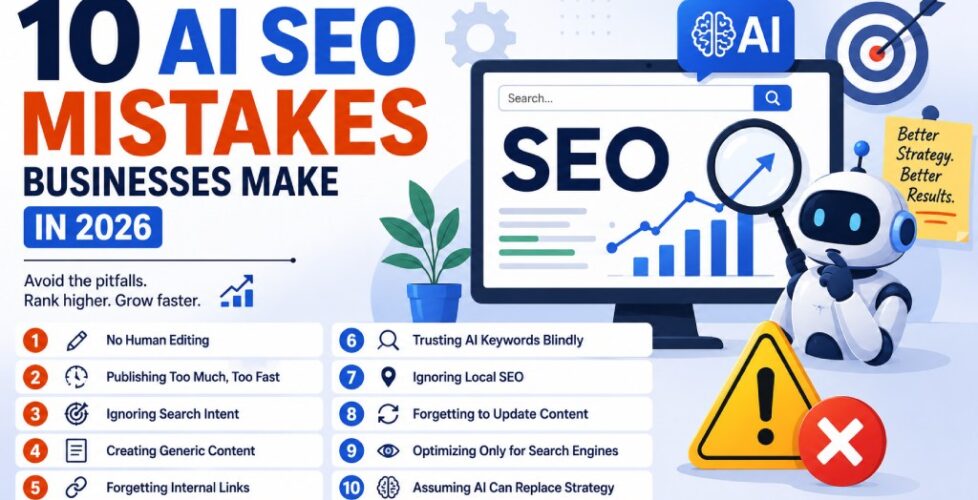
10 AI SEO Mistakes Businesses Make in 2026
Trust me when I say, AI has changed search engine optimization forever. In 2026, sites can create blog posts, analyze keywords, optimize pages, and even plan content in minutes. However, while AI has made SEO faster, it has also made it easier to make costly mistakes.
AI Delivers Marketing In Hours
Many companies assume AI can handle everything without any human input. Unfortunately, that approach often leads to lower rankings, weaker content, and fewer conversions. Google continues to reward websites that provide real value, not just content generated at scale.
If you want your business to grow in 2026, avoid these common AI SEO mistakes.
Using AI Without Human Editing
AI is an incredible writing assistant. Even so, it should never replace a final human review.
Many businesses publish AI-generated content without checking facts, improving readability, or adding their own expertise. As a result, articles often feel generic and fail to stand out from competitors.
Instead, treat AI like a first draft. Then, refine the content by adding examples, personal insights, and industry experience. Readers notice the difference, and so do search engines.
Publishing Too Much Content Too Quickly
Speed is one of AI’s biggest advantages. However, publishing dozens of articles in a single week does not guarantee better rankings.
Quality still matters far more than quantity.
Rather than flooding your website with average content, focus on creating helpful articles that solve real problems. Over time, a smaller collection of valuable posts usually performs much better than hundreds of weak pages.
Consistency beats volume almost every time.
Ignoring Search Intent
Many businesses choose keywords but forget to understand why someone is searching.
For example, a person searching for “best AI design software” probably wants comparisons. On the other hand, someone searching “how AI improves SEO” expects an educational guide.
If your content does not match the visitor’s expectations, they will leave quickly and your rankings may suffer because user engagement declines. Keep in mind that attention spans are small these days with tons of competition so stand out. Do better!
Before writing, ask yourself one simple question:
“What does the reader actually want?”
Creating Generic Content
One of the easiest ways to spot AI-written content is when every article sounds exactly the same.
Generic introductions, predictable conclusions, and repeated phrases no longer impress readers.
Instead, add unique examples, customer stories, opinions, or real-world experience. Your business already has knowledge that competitors do not.
AI provides a foundation. Your expertise creates authority.
Forgetting Internal Links
Many companies spend hours creating new content. Meanwhile, they forget to connect it to existing pages.
Internal links help visitors discover more information while guiding search engines through your website.
For example, if you publish an article about AI marketing, link it to your SEO services, content marketing pages, or related blog posts.
As a result, visitors stay on your site longer, and search engines better understand your website structure.
Trusting AI Keyword Suggestions Blindly
AI keyword tools are improving every year. Still, they should not be your only source of research.
 Sometimes AI recommends keywords that have little search volume or intense competition. Other times, it overlooks valuable long-tail opportunities.
Therefore, always verify keyword ideas with trusted SEO tools before building an entire content strategy around them.
A few minutes of research can save months of wasted effort.
Ignoring Local SEO
Businesses often chase national rankings while overlooking nearby customers.
If you serve a local area, your website should include location-specific pages, Google Business Profile optimization, local keywords, and customer reviews.
For example, a web design agency in Oregon should also target nearby cities instead of relying only on broad national keywords.
Local SEO remains one of the fastest ways to generate qualified leads.
Forgetting to Update Older Content
Many businesses focus only on publishing new articles. Unfortunately, older content slowly becomes outdated.
Statistics change.
Technology evolves.
Search habits shift.
Instead of constantly creating new posts, review older articles every few months. Update facts, refresh screenshots, improve headings, and add new information.
Often, refreshed content climbs search rankings much faster than brand-new articles.
Optimizing Only for Search Engines
SEO is important. Nevertheless, your visitors should always come first.
Some businesses stuff keywords into every paragraph or create awkward sentences simply to rank higher.
Modern search engines are much smarter than they were a few years ago.
Natural writing performs better because it keeps readers engaged.
If your article sounds like a conversation instead of a checklist, people are far more likely to keep reading.
Assuming AI Can Replace Strategy
Perhaps the biggest mistake of all is believing AI replaces experience.
AI is excellent at generating ideas, organizing information, and speeding up workflows. However, it cannot fully understand your customers, business goals, or competitive advantages.
Successful SEO still requires planning.
You need to identify your audience, build topical authority, monitor analytics, improve user experience, and adjust your strategy over time.
AI helps you work faster, but strategy determines whether your website succeeds.
Final Thoughts
AI has become one of the most powerful SEO tools available in 2026. It saves time, improves productivity, and helps businesses produce more content than ever before. Even so, relying on AI alone can create serious problems if you’re not careful.
The businesses seeing the best results use AI as a partner rather than a replacement. They edit every article, focus on user intent, build helpful resources, and continually improve their websites.
SEO continues to evolve, and so should your strategy. By avoiding these common mistakes, you’ll create content that serves both your audience and search engines. That’s the combination that leads to higher rankings, more traffic, and long-term business growth.
Frequently Asked Questions
Can AI completely replace SEO professionals?
No. AI speeds up research, writing, and optimization, but it cannot replace strategy, creativity, or industry expertise. Successful SEO still requires human oversight and ongoing analysis.
Does Google penalize AI-generated content?
Google does not penalize content simply because AI created it. Instead, it evaluates quality, usefulness, and relevance. Poor-quality content, whether written by AI or humans, is less likely to rank well.
Why is search intent important for SEO?
Search intent helps you create content that matches what users want to find. When your content answers their questions effectively, visitors stay longer and are more likely to engage with your website.
Should I update older blog posts?
Yes. Updating older content with fresh information, improved keywords, and current examples can boost rankings and extend the life of your existing content without creating new articles.
Is keyword stuffing still bad for SEO?
Yes. Overusing keywords makes content difficult to read and can hurt rankings. Use keywords naturally while focusing on creating helpful, informative content for your audience.
How often should I publish AI-assisted content?
Focus on quality rather than quantity. A consistent schedule of well-written, optimized articles usually performs better than publishing large amounts of low-quality content.
Can AI help with keyword research?
Yes. AI can generate keyword ideas and identify related topics. However, it's still important to verify search volume, competition, and user intent with reliable SEO tools.
Why are internal links important?
Internal links help visitors discover related content and make it easier for search engines to understand your website's structure. They can also improve user engagement and page authority.
What's the best way to use AI for SEO?
Use AI as a tool to speed up research, content creation, and optimization. Then, review, edit, and personalize the content with your expertise to ensure it delivers real value to readers.