How AI Is Reshaping Advertising Agencies
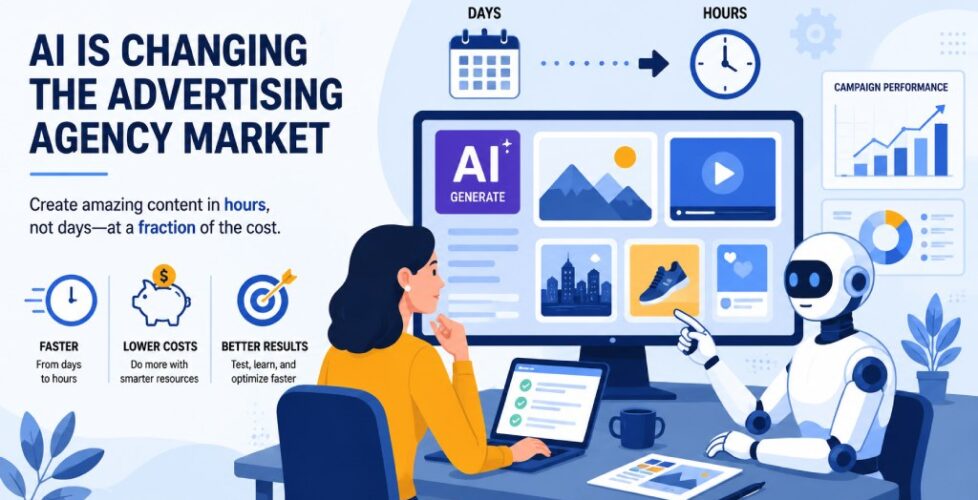
The advertising agency market is changing fast. Artificial intelligence (AI) is now helping agencies create graphics, videos, ad copy, and marketing campaigns in a fraction of the time. In the past, agencies often needed several days or even weeks to complete creative projects. Today, AI tools can help teams complete many of those tasks within hours.
As a result, businesses of all sizes are starting to rethink how they approach advertising. Smaller companies can now access high-quality creative work without paying traditional agency prices. At the same time, agencies are learning how to adapt their services to remain competitive in a rapidly changing industry.
AI is not replacing creativity. Instead, it is changing how creative teams work. Agencies that understand this shift are finding new ways to deliver faster results while still maintaining quality and strategy.
Faster Content Creation Is Changing Agency Workflows
Traditional advertising agencies often rely on large teams and long production timelines. A single campaign may involve graphic designers, copywriters, photographers, editors, and project managers. Although this structure can produce excellent work, it also increases costs and delays.
AI tools are streamlining many of these tasks. For example, designers can now use AI-powered software to create social media graphics, ad concepts, and branding ideas much faster than before. Likewise, copywriters can generate rough drafts, headlines, and campaign ideas in minutes instead of hours.
This speed matters because businesses now expect faster marketing cycles. Social media trends move quickly, and companies often need fresh content every day. Therefore, agencies that use AI can respond faster to client needs while keeping production costs under control.
A local business that once waited two weeks for a complete ad package may now receive multiple design options within a single day. Consequently, clients gain more flexibility and faster turnaround times.
AI Is Making Creative Services More Affordable
 One of the biggest changes in the advertising market is affordability. Traditional agencies often charge high fees because of labor-intensive workflows. However, AI reduces the amount of manual work required for many projects.
For example, AI image generators can quickly create concept art, banner ads, product visuals, and social media graphics. Meanwhile, AI writing tools can assist with blog posts, ad copy, and email campaigns. Because production time is lower, agencies can offer more competitive pricing.
This shift benefits startups and small businesses the most. In the past, many smaller companies simply could not afford professional advertising campaigns. Now, AI-assisted agencies can provide quality creative services at lower price points.
However, lower pricing does not always mean lower quality. In many cases, AI allows agencies to spend less time on repetitive tasks and more time focusing on strategy, branding, and client communication.
Human Creativity Still Matters
Despite the growth of AI, human creativity remains essential. AI tools can generate ideas and visuals, but they still need direction, editing, and quality control.
For example, AI may create several logo concepts within minutes. However, a skilled designer still needs to refine the final product so it matches the client’s brand identity. Similarly, AI-generated blog content often requires human editing to improve tone, accuracy, and originality.
This is an important point because many people worry that AI will completely replace agencies. In reality, the market is moving toward collaboration between humans and technology.
Experienced creative professionals still understand emotional storytelling, customer psychology, and brand positioning better than software alone. Therefore, the agencies that combine AI efficiency with human expertise are likely to perform the best.
AI Helps Agencies Scale Faster
AI is also helping agencies handle more clients without dramatically increasing staff size. Traditionally, agency growth required hiring larger teams. Today, AI automation allows smaller teams to manage larger workloads.
For instance, agencies can automate social media scheduling, reporting, basic customer support, and performance analysis. Additionally, AI-powered analytics tools can quickly identify which campaigns are performing well and which ones need improvement.
As a result, agencies can focus more attention on strategic decisions instead of spending hours on repetitive administrative tasks.
This scalability creates opportunities for smaller agencies and freelancers. A small AI-assisted creative team can now compete with larger agencies in ways that were difficult just a few years ago.
There Are Still Challenges and Limitations
Although AI offers major advantages, there are still important limitations. AI-generated content is not always accurate, original, or brand-safe. Therefore, agencies must carefully review everything before publishing campaigns.
There are also concerns about originality. Since AI models learn from existing content, some businesses worry about content looking generic or repetitive. Consequently, agencies need strong creative direction to make campaigns stand out.
Another challenge involves client trust. Some companies still prefer traditional creative processes because they value human craftsmanship and custom design work. In addition, certain industries require careful messaging that AI may not fully understand.
For example, healthcare, finance, and legal advertising often involve strict regulations. Human oversight remains critical in these sectors because inaccurate messaging can create serious problems.
Furthermore, AI cannot replace strong relationships between agencies and clients. Successful advertising still depends on communication, trust, and understanding customer goals.
The Future of Advertising Agencies
The future of advertising agencies will likely involve a hybrid approach. AI will continue handling repetitive production tasks, while humans focus on strategy, storytelling, and brand development.
Agencies that ignore AI may struggle to compete on pricing and speed. On the other hand, agencies that rely entirely on automation may produce generic work that lacks emotional connection.
The strongest agencies will probably combine both strengths. They will use AI to increase efficiency while still investing in experienced creative professionals.
This balanced approach can help agencies deliver faster results without sacrificing quality. Moreover, it allows businesses to access professional marketing services at more realistic price points.
As technology continues to improve, clients will likely expect faster turnaround times and more affordable creative services. Therefore, agencies must adapt their workflows to remain competitive.
Conclusion
Artificial intelligence is reshaping the advertising agency market in practical and measurable ways. AI tools are helping agencies create content faster, reduce costs, and improve efficiency. At the same time, businesses are gaining access to more affordable creative services.
However, AI is not eliminating the need for human creativity. Instead, it is changing the role of creative professionals. Agencies still need strategy, storytelling, branding expertise, and strong client relationships to succeed.
The advertising industry is entering a new phase where speed and creativity must work together. Agencies that learn how to combine AI tools with human insight will likely remain competitive in the years ahead.
Rather than replacing agencies entirely, AI is pushing the market toward smarter workflows, leaner production systems, and more accessible creative services for businesses of all sizes.